
Saturday, July 21, 2018


Tuesday, November 21, 2017
Collaboration with Wijnand Steemers
Poems inspired by the photographs in Classic Mode: A Reverie
by Gregg Simpson, New Arcadia Publishing, Vancouver, 2008
Translated from the original Dutch by the author
in a buddhist monastery or during a yoga session, not
on a bank with a view at a park or sea, not
in the seventh heaven of a long-lasting orgasm, not
at the toilet or at the dentist's waitingroom reading magazines, not
to the roadside to take a rest from a long drive, not
during the reading of a good poem, nor this one, not
at the back of the ship of the desert, not
on a air bed, bobbing up and down an austrian lake, not
certainly not, perhaps, no, maybe, not at all, not
after the silence of a lost football match, not
standing before these solemn pillars, no, probably not
but in our improperly long-lasting stare at this stone globe, oh yes
when the gods had stopped to play at marbles
Thursday, October 26, 2017
Art criticism today is beset by art historians turned inside out to function as prophets of so-called inevitable trends. A determinism similar to that projected into the evolution of past styles is clamped upon art in the making. In this parody of art history, value judgments are deduced from a presumed logic of development, and an ultimatum is issued to artists either to accommodate themselves to these values or be banned from the art of the future. An aesthetician founded on art history wields a club of dogma similar to moralistic criticism in the nineteenth century or political criticism in the Soviet Union.
Dead art movements are the normal life of art; all that can be expected of them is good painting.
In regard to creation there is nothing to indicate that a new art movement has any advantage over an obsolete one; the contrary may well be the case.
After 1972 anyone could be an artist, except, perhaps, painters and sculptors.
No degree of dullness can safeguard a work against the determination of critics to find it fascinating.
Edwin Varney
 Geoff Chris Olson (Vancouver Courier)
I recognize that artists must seek new means of expression to remain vibrant and relevant, and that censoring bad art will only make matters worse, but the bar of what is classified as art has been lowered so much that anything, no matter how moving or mindless, is treated equally. The fault lies less with these "artists" than with the politically motivated ignoramuses who allow such work to be funded.
Vincent Van Gogh
The buying and selling of art is nothing more than organized robbery.
- When the demagogues of art call on you to make the good art, the intelligible art, the social art, spit down on them and go back to your dreams, your mirror and the World.
Probably to normal people the smirky art and the death art are all the same old onions, and, if so, I kind of know what they mean. But anyway King Death is Joseph Beuys and Queen Death is Louise Bourgeois. King Smirky is Jeff Koons and Prince Smirky is Damien Hirst. So this is definitely a Beuys and Bourgois type show. Long faces all round.
Pablo Picasso
Pierre-August Renoir
Robert Motherwell (from a 1944 lecture)

I am a free man. I do not work for a padrone, or a boss. I am indifferent to things that do not interest me. But never would I attack them. Especially in the creative arts. Because I say anybody who does creative art is a sacred person. I do not care what he does. Whether he paints academic pictures, or he is modern, or different from anything else. He cannot do any harm. Whereas a bad politician, or a bad doctor, or a bad cook can kill you!"
Donald Judd
Bridget Riley
Dr. W. Grampp
Jose Pierre
Sunday, November 22, 2015
Regarding the new book and Facebook Community, Vancouver Vanishes, I have to say it reminds me of the Modernist heritage battle I was part of in the early 1990's over the fate of the Main Branch Library, a silver Governor General's award winning building designed by Semmens and Simpson in 1957.
It's not that different an issue in the sense that the old character homes being leveled for the uber rich are the victims of the same old gang: greedy developers, super wealthy buyers who care nothing for Vancouver's history and may not even live in these giant houses, plus weasel politicians who dance to their tune.

Like Caroline Adderson, co-author of both the book, Vancouver Vanishes and the Facebook Community of the same name, I believe whether it's character homes from the early 20th Century or the mid-century West Coast Modernism of my father's generation, we need a collective roar of disapproval from Vancouver's caring citizens.
This never came in the Library issue because at that time Modernism was the enemy. One wag wrote to the Georgia Straight calling that building "evil, phallic Modernism", despite the actual shape of the place. I blame many academics for fostering this ignorant attitude by systematically, and with the apparent blessing of so-called Post Modernist critics, laying at the feet of this movement all the ills of western society.
Doubtless they would say these early houses now being destroyed are relics of colonial and eurocentric thinking and are better off gone. Like the architect of the new library, Moshe Safdie, who called the attempts to save the old library nothing but sentimentality, we are again being over run by a cabal who cares nothing for Vancouver history, short as it is, who will remind us that, like the old Main Branch VPL, these structures are not worth saving.
I urge everyone to write Vancouver City Council and join with Caroline in her efforts to save our heritage: https://www.facebook.com/VancouverVanishes/
Monday, July 13, 2015
Let
in the Infinite?
Text
by Paul McRandle
Collages
by Gregg Simpson

Let in the infinite? What a racket it makes
tumbling from the closet like a host of clown-shaped sponges rising in a water
jug. The infinite is a porpoise trained by the CIA to attach listening devices
and strange boring mechanisms that harvest the words onboard along with every
noise—forever. So there isn’t to be more said than what might occur in the hull
of a Russian trawler.

I’m sitting on shore sucking a lozenge, pondering
the shapes in the waves, the shadows of the surf, rocks, subtle things fleeing
out to the horizon. It’s my way of garnering some bit of the world in this
hideous present. The sea is a vast personality. A twisting, confused melange of
impulses at war with itself and the world on every scale—diatoms having it out
with flagella, carcids rising from sandy pits to pinch off angelfish fins,
mankind scouting about above like children rubbing their butts against asphalt,
dragging their deep-weighted prisons.

It’s a numberless volume of death, energy, chaos, night, and we can do little more than watch its light from the shoreline flashing up towards the infinite from the skin of that denser infinite beneath.
A Phony War
Text by Paul McRandle
Text by Paul McRandle
Collages
by Gregg Simpson

A phony war plagued the Balkans for the off-seasons
of three consecutive decades. Generals babbled on television screens to the
populace about necessary sacrifices to avoid the devastating consequences of an
unjust peace. For Shlomo, it was a weary day when he finally had to pack up his
family and move to a place in which he might be able to read a newspaper
without unattributed sources speculating on the necessity of continued attacks.
He found a roadster with a roof rack and attached a wide trailer to a new
hitch.

With these he was able to pack a lifetime’s
collection of pewter figurines, ewers, world atlases, and a range of pot plants
from the exquisitely hued to the shockingly poisonous. His children rode in the
trailer, playing cards on an old canasta table and inviting passersby to gamble
with them. His wife drove and he consulted atlases at random to lead them
across the continents in search of an intelligible realm.
The passage over the Rhine into Austria involved
acts of bribery he would have shunned in previous days. The guards were the
usual sadists and Shlomo’s display of tears and hat-wringing, an act he’d
practiced before in dealing with this border, proved insufficiently degrading.

He was asked
to unhitch the trailer and de-articulate the transmission of his roadster to
demonstrate neither contained a bomb. When that had been done, they impounded
the roadster anyway and Shlomo understood that it was the only bargaining chip
he had. He left pulling the trailer, a roadster short, while wife and kids
alternately heckled him and played canasta.
What kind of a life had he let himself in for? He
took counsel on occasion from his wise namesake, but as he trod the bitter
miles he found himself increasingly bereft of uplift. He never had these kinds
of problems. What kind of advice could a guy like him give a Balkan refugee?
Shlomo shuddered on, feet plunging into the muck of the road until he’d sunk to
the shins and then the knees.

He urged his family to climb out and help him, but
they rigged a sail and set off across the mire sea without him, waving and
wishing him well as they dwindled in the distance.

He was truly encased, couldn’t move a toe, and felt
vermin crawling about his calves. With some internal tugging, however he found
that very gradually he could slough off his external husk, pulling himself up
through aged skin and disposable organs until he managed to climb out his own
mouth—happily he didn’t get turned around—and land with a splash naked on the
ground.

His new form had pleasing adaptations. He possessed
a large and daunting third ear in the middle of his back and his eyes could be
removed and relocated to sockets scattered across his body. He possessed a
spare brain in a bucket, which would do him some good so long as he held onto
it. His feet had long growths jutting forward from the toes like two ski-tips,
allowing him to glide across the muck with grace. This wasn’t the body he
wanted, but it wasn’t the world he wanted either.
Wednesday, February 5, 2014
THE VANCOUVER SCHOOL OF COLLAGE
Exhibition: UBC Fine Arts Gallery 1971
bill bissett, Christos Dikeakos, Gilles Foisy, Gary Lee Nova
Al Neil, Terry Reid, Gregg Simpson, Ed Varney, davis uu, Jeff Wall, Ian Wallace,
Michael Morris and Vincent Trasov.

Review by Richard Simmins in the Vancouver Sun
A
little known fact
about today's so-called Vancouver
School of photo-based conceptualism is that the original
exhibition at UBC, which used this term first, also included
several
other artists who were not part of any academic coterie. This was a
time when the battle lines hadn't
yet been drawn between the different groups in Vancouver's
developing avant garde art scene, which led Vancouver Province reviewer,
Joan Lowndes, to write: "As though through some time-warp surrealism has returned, along with alchemical visions, pop, eroticism, political satire and protest in the free-wheeling spirit of the West Coast".
What is amazing is that five of the six artists in the Canadian West Coast Hermetics exhibition, which was also launched from the UBC Fine Arts Gallery to tour Europe and eastern Canada in 1973-'74, were also in this show. However, following the mid-1970's the photo-conceptualists in this exhibition began an un-precedented, but well documented, collusion with the Vancouver Art Gallery to promote the idea that theirs was the only artistic movement that Vancouver would be known for. Protests over this were met with threats of defamation lawsuits.
With a dismissive attitude, they advocated exluding all traces of West Coast Surrealism from not only the VAG' s collection, but any further exhibitions, discussions, historical surveys, or publications at the gallery in the future. Serious critical attention did keep coming for the surrealists in the exhibition, but it was almost all from Ontario, or Quebec, and even more so from Europe and Latin America.
Thus the "free-wheeling spirit of the West Coast" demonstrated in this exhibition in 1971 was buried in the mid-1970's by an unprecedented cronyism, characterised by a desire to keep out any other group of artists with a different philosophy from the inner circle of the Vancouver art scene.
Joan Lowndes, to write: "As though through some time-warp surrealism has returned, along with alchemical visions, pop, eroticism, political satire and protest in the free-wheeling spirit of the West Coast".
What is amazing is that five of the six artists in the Canadian West Coast Hermetics exhibition, which was also launched from the UBC Fine Arts Gallery to tour Europe and eastern Canada in 1973-'74, were also in this show. However, following the mid-1970's the photo-conceptualists in this exhibition began an un-precedented, but well documented, collusion with the Vancouver Art Gallery to promote the idea that theirs was the only artistic movement that Vancouver would be known for. Protests over this were met with threats of defamation lawsuits.
With a dismissive attitude, they advocated exluding all traces of West Coast Surrealism from not only the VAG' s collection, but any further exhibitions, discussions, historical surveys, or publications at the gallery in the future. Serious critical attention did keep coming for the surrealists in the exhibition, but it was almost all from Ontario, or Quebec, and even more so from Europe and Latin America.
Thus the "free-wheeling spirit of the West Coast" demonstrated in this exhibition in 1971 was buried in the mid-1970's by an unprecedented cronyism, characterised by a desire to keep out any other group of artists with a different philosophy from the inner circle of the Vancouver art scene.
The main point is that
by using a publically funded gallery for the sole advancement of their own
careers, the so-called
Vancouver School of today made a once open minded
public gallery into their private club with no inclination to return to
the
'free wheeling spirit of the West Coast."
One can only surmise what things would have been like if fairness and objectivity had prevailed instead.
One can only surmise what things would have been like if fairness and objectivity had prevailed instead.
Saturday, January 11, 2014
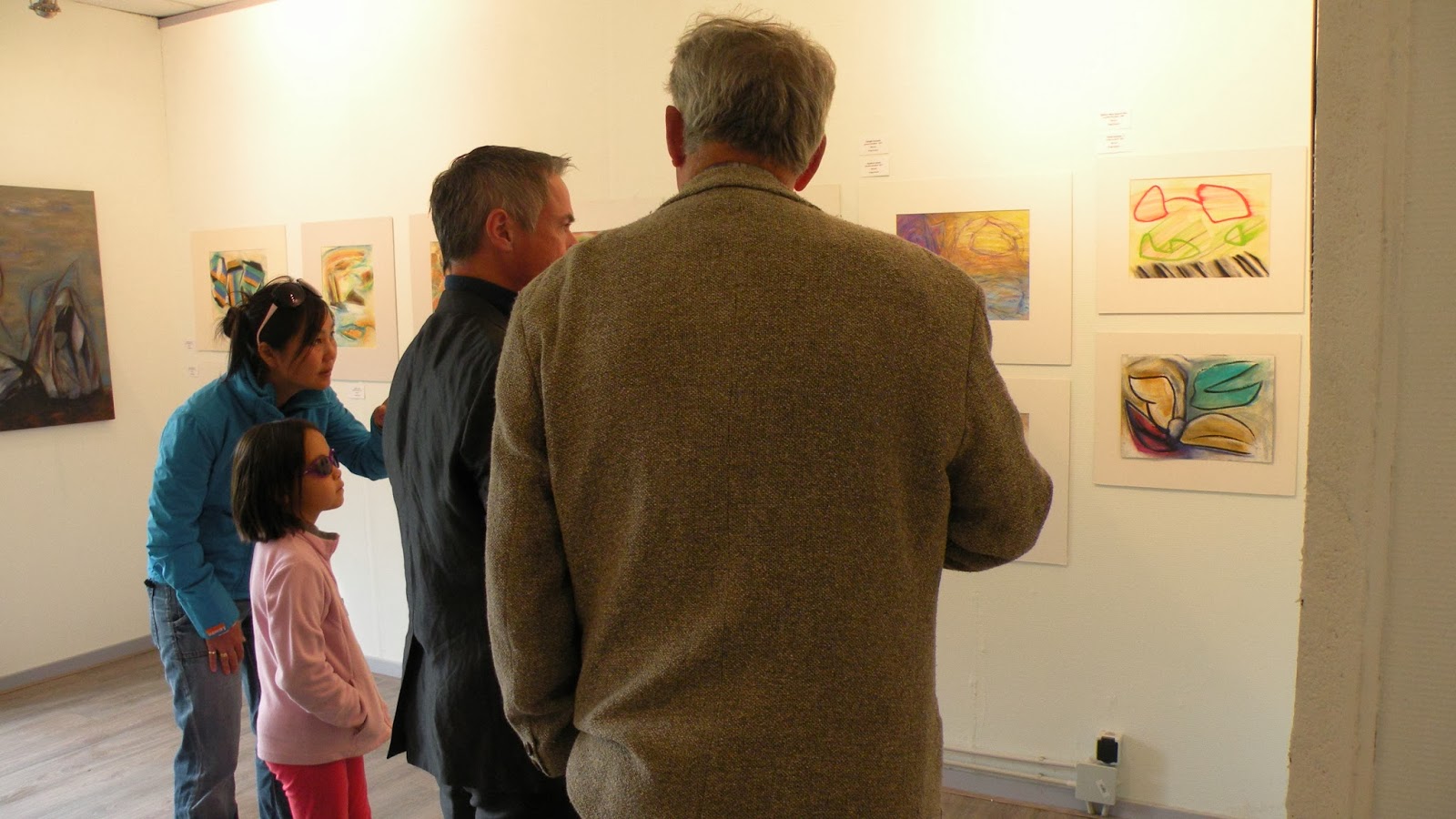
I can recommend the Rouges-en-Verts Atelier and Gallery as a great place to get some serious painting done. During April and May of 2013 I produced fifteen canvases and numerous works on paper. Art Materials are available in nearby Alencon, or at the Bricollage in l'Aigle, where you can catch a train to Paris.

The series is called Perche Mode and it reflects the light of this beautiful region of Normandy.

The studio where I completed a group of work begun in 2012 and the spacious gallery where
I exhibited both paintings and works on paper from 2008-2013.
Subscribe to:
Posts (Atom)
